| John Coltrane: "Blue Train" (Blue Note, Jan. 1958) | |
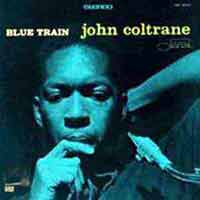
Ein eher unbekanntes Album des größten Saxofonisten des Jazz, noch vor seiner Zeit bei Atlantic und Impulse. Wohl sein einziges bei Blue Note. Mit der bewährten Rhythmusgruppe von Miles Davis (Schlagzeuger Philly Joe Jones und Bassist Paul Chambers), Kenny Drew am Piano, Posaunist Curtis Fuller und Trompeter Lee Morgan war das sogar ein Sextett mit drei Bläsern.

 Mehr ...
This album, recorded in September 1957, marked John Coltrane’s comeback after his heroin use led to his ejection from Miles Davis’ band earlier in the year. After going cold turkey and successfully beating his addiction, Coltrane was a man reborn whose music became more sharply focused, especially after he began working with Thelonious Monk. He was still playing with Monk’s quintet when he recorded Blue Train with a sextet that included young trumpet genius Lee Morgan. All but one of the tunes is by the saxophonist, and it’s the title cut, with its memorable clarion call theme, which is the stand-out. Widely acknowledged as Trane’s first masterpiece, anyone looking to buy John Coltrane for the first time needs to start here. Blue Train was the first of several musical masterpieces that Coltrane would create in his short recording career. It came at a time when the saxophonist, who had transformed his life after overcoming heroin addiction, was playing with Thelonious Monk and honing his famous “sheets of sound” style. Though “Trane” had a deal with Prestige, he negotiated to do a one-off LP for Blue Note. The resulting album, rendered in a hard bop style, was the catalyst that kick-started his solo career. Thanks to the presence of Curtis Fuller’s resonant trombone, Blue Train offered a unique sonic signature with its three-horn frontline. It also showcased Coltrane’s advances as both an improviser and composer, especially on the magnificent title track and “Locomotion.” Although never formally signed, an oral agreement between John Coltrane and Blue Note Records founder Alfred Lion was indeed honored on Blue Train -- Coltrane's only collection of sides as a principal artist for the venerable label. The disc is packed solid with sonic evidence of Coltrane's innate leadership abilities. He not only addresses the tunes at hand, but also simultaneously reinvents himself as a multifaceted interpreter of both hard bop as well as sensitive balladry -- touching upon all forms in between. The personnel on Blue Train is arguably as impressive as what they're playing. Joining Coltrane (tenor sax) are Lee Morgan (trumpet), Curtis Fuller (trombone), Kenny Drew (piano), Paul Chambers (bass), and Philly Joe Jones (drums). The triple horn arrangements incorporate an additional sonic density that remains a trademark unique to both this band and album. Of particular note is Fuller's even-toned trombone, which bops throughout the title track as well as the frenetic "Moments Notice." Other solos include Paul Chambers' subtly understated riffs on "Blue Train" as well as the high energy and impact from contributions by Lee Morgan and Kenny Drew during "Locomotion." The track likewise features some brief but vital contributions from Philly Joe Jones -- whose efforts throughout the record stand among his personal best. Of the five sides that comprise the original Blue Train, the Jerome Kern/Johnny Mercer ballad "I'm Old Fashioned" is the only cover tune in the stack. In terms of unadulterated sentiment, this version is arguably untouchable. Fuller's rich tones and Drew's tastefully executed solos cleanly wrap around Jones' steadily languid rhythms. This is sheer jazz nirvana. In the spring of 1997, the Ultimate Blue Train CD was released, boasting 20-bit remastered audio as well as one alternate take of both "Blue Train" and "Lazy Bird." Additionally, the disc includes "At Least Listen" -- an interactive CD-ROM program featuring video clips and interview clips with Fuller circa 1995, as well as many brilliant photographs taken during the recording sessions. Without reservation, Blue Train can easily be considered in and among the most important and influential entries not only of John Coltrane's career, but of the entire genre of jazz music as well. (by Lindsay Planer, All Music Guide) Recorded as a one-off while he was still contracted to the Prestige label, Blue Train was John Coltrane’s only solo offering for Alfred Lion and Francis Wolff’s imprint. Recorded in late 1957, after the saxophonist had gone “cold turkey” to quit the heroin addiction that got him fired from Miles Davis’ band earlier in the year, Blue Train marked his rebirth as a drug-free musician. Perhaps because of this, it was Trane’s first truly exceptional long-player and showed him living up to the promise he had shown before drugs threatened to derail his career. Coltrane leads a sextet with a three-horn frontline that includes trumpeter Lee Morgan and trombonist Curtis Fuller, the latter bringing a rich sonority to the album. The opening title tune, with its memorable clarion call horn theme, is one of Coltrane’s classic compositions and offers a vivid example of his ornate “sheets of sound” soloing style in a hard bop setting. The only cover among the album’s five tunes is the Johnny Mercer-Jerome Kern-written ‘I’m Old Fashioned’, a plaintive ballad on which Coltrane favours deep emotional expression over flashy displays of technique. Not only an essential entry in any guide to Blue Note, but one of the first ports of call for anyone interested in John Coltrane, Blue Train is a must-hear album. (www.udiscovermusic.com) |
|
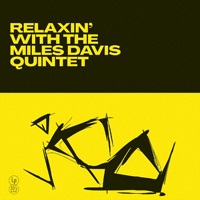
| Miles Davis: "Relaxin' With The Miles Davis Quintet" (Prestige, März 1958) | |
 Mehr ...
»Relaxin’ with the Miles Davis Quintet« ist in jeder Form ein Meisterstück. Miles Davis (Trompete) gründete 1955 die Band mit seinen Kollegen John Coltrane (Tenorsaxophon), Red Garland (Piano), Paul Chambers (Bass) und Philly Joe Jones (Schlagzeug). Zu dieser Zeit gehörten sie noch nicht zu den ganz Großen in der Branche. Dieses Album - »Relaxing with the Miles Davis Quintet« – und seine Pendants aus der Prestige Reihe (Cookin’, Workin’ and Steamin’ with the Miles Davis Quintet) etablierten Miles Davis wieder in der oberen Jazz Liga. Ab dem Zeitpunkt gehörten er und sein Quintet zu der kleinen Gruppe der besten Jazz Combos überhaupt. Die Einspielung bekam den Namen »Relaxin’« aufgrund der balladenartigen Ausführung und verschiedener sehr leichter Parts. Das Album »Relaxin’« verbleibt auf jeden Fall als eins der lebensfrohen Werke von Miles Davis und als eines der besten Beispiele für eine der herausragenden Jazz Quintette des 20. Jahrhunderts. Relaxin' features the Miles Davis Quintet in a pair of legendary recording dates -- from May and October of 1956 -- which would generate enough music to produce four separate long-players: Cookin', Relaxin', Workin', and Steamin'. Each of these is considered not only to be among the pinnacle of Davis' work, but of the entire bop subgenre as well. As with the other titles, Relaxin' contains a variety of material which the band had concurrently been performing in their concert appearances. In a brilliant stroke of time conservation, the scheme was hatched for the quintet -- who includes: Davis (trumpet), John Coltrane (tenor sax), Philly Joe Jones (drums), and Red Garland (piano) -- to perform the equivalent of their live repertoire in the studio for eventual release. The results are consistently superior both in terms of song selection as well as performance. The solid nature of the unit as a singular musical force is immediately apparent. "If I Were a Bell" -- from the play Guys and Dolls -- includes some remarkable soloing via Coltrane and Garland. Davis' solos are additionally impressive, as they're derived from the same four-note motive as the melody. Hearing the many variations that he comes up with throughout the song conveys how intrigued Davis must have been by the tune, as it stayed in his performance repertoire for decades. Tracks such as "You're My Everything" and "Oleo" highlight the synchronic nature of Davis and Coltrane as they carry each other's melodies while trading off solos. The steady syncopation of Philly Joe Jones keeps the rhythms tight and the delicate interplay all the more conspicuous. Relaxin' offers something for every degree of jazz enthusiast. Likewise, the quintet's recordings provide a tremendous introduction for the curious jazz consumer. (by Lindsay Planer, All Music Guide) |
|
| Sonny Clark: "Cool Struttin'" (Blue Note, Aug. 1958) | |
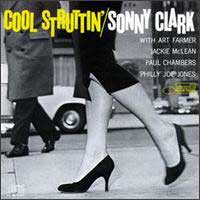
Ein echter Hardbob-Klassiker in jedem Fall - vielleicht sogar das Blue-Note-Album-Schlechthin? Ich kenne kaum etwas mit mehr Swing als diese Aufnahmen des oft unterschätzten Pianisten, hier zusammen mit dem Trompeter Art Farmer, dem Altsaxofonisten Jackie McLean und der ein Jahr später durch das Miles Davis-Album "Kind Of Blue" weltbekannt werdenden Rhythmusgruppe mit Schlagzeuger Philly Joe Jones und Bassist Paul Chambers.
(2006-08-08)
Mehr ...
Recorded in 1958, this legendary date with the still-undersung Sonny Clark in the leader's chair also featured a young Jackie McLean on alto (playing with a smoother tone than he had before or ever did again), trumpeter Art Farmer, and the legendary rhythm section of bassist Paul Chambers and drummer Philly Joe Jones, both from the Miles Davis band. The set begins with one of the preeminent "swinging medium blues" pieces in jazz history: the title track with its leveraged fours and eights shoved smoothly up against the walking bass of Chambers and the backbeat shuffle of Jones. Clark's solo, with its grouped fifths and sevenths, is a wonder of both understatement and groove, while Chambers' arco solo turns the blues in on itself. While there isn't a weak note on this record, there are some other tracks that stand out, most notably Miles' "Sippin' at Bells," with its loping Latin rhythm. When McLean takes his solo against a handful of Clark's shaded minor chords, he sounds as if he may blow it -- he comes out a little quick -- but he recovers nicely and reaches for a handful of Broadway show tunes to counter the minor mood of the piece. He shifts to both Ben Webster and Lester Young before moving through Bird, and finally to McLean himself, riding the margin of the changes to slip just outside enough to add some depth in the middle register. The LP closes with Henderson and Vallée's "Deep Night," the only number in the batch not rooted in the blues. It's a classic hard bop jamming tune and features wonderful solos by Farmer, who plays weird flatted notes all over the horn against the changes, and McLean, who thinks he's playing a kind of snake charmer blues in swing tune. This set deserves its reputation for its soul appeal alone. [The CD version includes two bonus tracks: "Royal Flush" and "Lover"]. (by Thom Jurek, All Music Guide) Conrad “Sonny” Clark was a hard bop pianist from Pennsylvania who lived fast and died young. Regarded as his magnum opus, Cool Struttin’ was the seventh of nine albums he recorded for Blue Note during a fertile five-year stay. The album features a two-horn frontline consisting of altoist Jackie McLean and trumpeter Art Farmer, who are underpinned by a rhythm section comprised of Miles Davis’ then bassist Paul Chambers and drummer Philly Joe Jones. From the soulful, swaggering title track to the hard-swinging “Blue Minor” and “Sippin’ At Bells,” Cool Struttin’ showcases the virtues of the hard bop style at its creative apex. |
|
| Ahmad Jamal Trio: "At The PERSHING - But Not For Me" (Argo, Aug. 1958) | |
 Mehr ...
Ahmad Jamals Trio bestand aus der Besetzung Piano, Gitarre und Bass. Ab 1957 wurde die Gitarre durch Schlagzeug als Instrument abgelöst und das Trio bestand seitdem aus Pianist Ahmad Jamal, Israel Crosby (bass) und Vernell Fournier (drums). The first album by the trio of pianist Ahmad Jamal, bassist Israel Crosby, and drummer Vernell Fournier was a big seller partly due to the classic rendition of "Poinciana." The live LP (which unfortunately has only 29 minutes of music) features very tight interplay among the musicians and light but passionate versions of such other songs as "But Not for Me," "Surrey With the Fringe on Top," and "Woody 'n You." A classic that really defined Ahmad Jamal's distinctive sound in many people's minds. (by Scott Yanow, All Music Guide) |
|
| Art Famer: "Farmer's Market" (Prestige, 1958) | |
 Aufnahmen vom 23.11.1956 im Quintett mit Hank
Mobley (tsax), Kenny Drew (p), dem leider früh verstorbenen
Zwillingsbruder Addison Farmer (db) und Elvin Jones (dr).
Damals konzentrierte sich Art Farmer noch nicht auf das lyrische Flügelhorn,
sondern zeigte sich auch auf der "normalen" Trompete als Meister.
Aufnahmen vom 23.11.1956 im Quintett mit Hank
Mobley (tsax), Kenny Drew (p), dem leider früh verstorbenen
Zwillingsbruder Addison Farmer (db) und Elvin Jones (dr).
Damals konzentrierte sich Art Farmer noch nicht auf das lyrische Flügelhorn,
sondern zeigte sich auch auf der "normalen" Trompete als Meister.(09.07.2009)
Mehr ...
In 1956, trumpeter Art Farmer was teamed with tenor saxophonist Hank Mobley and pianist Horace Silver in one of the most vital and important modern jazz groups of the seminal hard bop era. But it was Farmer here who was emerging as a leader, with Mobley tagging along on this excellent date. Not to say that Mobley was a slouch, and indeed far from it as a peer of Sonny Rollins and John Coltrane. Fact is, Mobley led the band with Farmer and Silver, but achieved his greatest acclaim alongside trumpeters Lee Morgan, and eventually Miles Davis. For Farmer, this recording was a coming out party, establishing him not only as a fine player, but a composer who lyricists were attracted to. "Farmer's Market" with its by now immortal swift hard bop melody and harmony courtesy of the Farmer/Mobley tandem, and the languid ballad "Reminiscing" with Mobley out but pianist Kenny Drew adding reinforcement a hundredfold, were covered vocally later on by Annie Ross and Earl Coleman respectively. Twin brother Addison Farmer stokes the coals on bass for the hard swinging "Wailin' with Hank," goes for a cool blues groove as the horns play a unison line on "Ad-Dis-Un," and strokes a bluesy swing during "By Myself" as another feature for the trumpeter, in this case with mute, and Mobley sitting out. Drummer Elvin Jones, who sounds like a more sensitive rhythm pilot instead of the powerhouse he would become with John Coltrane, plays his role as an intent listener and firm contributor without pushing the envelope. His style on the recording deserves a close inspection, vis à vis what he would become a decade later. Considering this is early period Farmer, and that his work after leaving the U.S. for Europe led him to playing the softer toned flugelhorn and trumpet exclusively, it is an important document in his legacy, comparing favorably alongside peers Clifford Brown, Miles Davis, and an also emerging Donald Byrd or Lee Morgan. (by Michael G. Nastos, All Music Guide) |
|
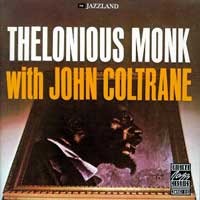
| "Thelonius Monk with John Coltrane" (Riverside/Jazzland, 1958) | |
 Mehr ...
|
| << 1957 | Oben | 1959 >> |
| Erstellt: 13.01.2009 | Letzte Aktualisierung: 04.08.2026 17:10 | 13502 Besucher seit dem 13.01.2009 |
| Homepage im neuen Fenster | We´re Waiting For Louise! | © Webmaster: |