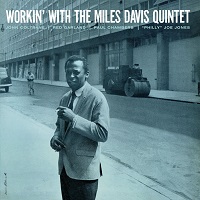
| Miles Davis: "Workin' With The Miles Davis Quintet" (Prestige, Jan. 1960) |

 Mehr ...
|
Trumpeter Miles Davis led several sessions for Prestige Records between
November 1955 and October 1956 with his legendary "first" quintet,
featuring tenor saxophonist John Coltrane, pianist Red Garland, bassist
Paul Chambers, and drummer Philly Joe Jones. The sessions represent an
incomparable musical legacy. Impeccably engineered by Rudy Van Gelder,
the music was released on five albums that provide a unique glimpse at
how five brilliant instrumentalists coalesced into one of the most extraordinary
ensembles in modern jazz. Workin' presents an easygoing program that balances
ballads with the blues and includes quintet performances of originals
by Davis ("Four," "Half Nelson"), Coltrane ("Trane's
Blues"), and Dave Brubeck ("In Your Own Sweet Way"); an
interpretation of the standard "It Never Entered My Mind" without
saxophone; and a piano-trio version of Ahmad Jamal's "Ahmad's Blues."
Coltrane's melancholy solo on Brubeck's tune and Garland's spry excursion
on Coltrane's are two of this classic's many highlights.
(amazon, Mitchell Feldman)
|
|
| Miles Davis's 1956 Quintet was one of his classic groups,
featuring tenor-saxophonist John Coltrane, pianist Red Garland, bassist
Paul Chambers and drummer Philly Jo Jones. They recorded four albums for
Prestige in two marathon sessions. Among the highlights are It Never Entered
My Mind, Four, In Your Own Sweet Way and two versions of The Theme. The
music is essential in one form or another. 8 tracks. From the OJC/ Prestige
label. |
|
|
Workin' is the third in a series of four featuring the classic Miles
Davis Quintet: Davis (trumpet), John Coltrane (tenor sax), Red Garland
(piano), and Philly Joe Jones (drums). Like its predecessors Cookin' and
Relaxin', Workin' is the product of not one -- as mythology would claim
-- but two massively productive recording sessions in May and October
of 1956, respectively. Contradicting the standard methodology of preparing
fresh material for upcoming albums, Davis and company used their far more
intimate knowledge of the tunes the quintet was performing live to inform
their studio recordings. As was often the case with Davis, the antithesis
of the norm is the rule. Armed with some staggering original compositions,
pop standards, show tunes, and the occasional jazz cover, Workin' is the
quintessence of group participation. Davis, as well as Coltrane, actually
contributes compositions as well as mesmerizing performances to the album.
The band's interaction on "Four" extends the assertion that
suggests this quintet plays with the consistency of a single, albeit ten-armed,
musician. One needs listen no further than the stream of solos from Davis,
Coltrane, Garland, and Jones, with Paul Chambers chasing along with his
rhythmic metronome. Beneath the smouldering bop of "Trane's Blues"
are some challenging chord progressions that are tossed from musician
to musician with deceptive ease. Chambers' solo stands as one of his defining
contributions to this band. In sly acknowledgement to the live shows from
which these studio recording sessions were inspired, Davis concludes both
sets (read: album sides) with "The Theme" -- a brief and mostly
improvised tune -- indicating to patrons that the tab must be settled.
In this case, settling the tab might include checking out Steamin', the
final Miles Davis Quintet recording to have been culled from these historic
sessions.
(by Lindsay Planer, All
Music Guide)
|
|
| Johnny Cash: "Ride This Train" (Columbia, März 1960) |
 Ein
frühes Cash-Album, auf das ich aber neulich erst gestossen bin. Alle
Lieder haben was mit Zügen zu tun. Sozusagen ein "Konzeptalbum",
obwohl es so was damals wohl noch nicht gab. Enthält keinen der üblichen
Cash-Klassiker, die man schon von ...zig Zusammenstellungen kennt. Und
das ist gut so. Ein
frühes Cash-Album, auf das ich aber neulich erst gestossen bin. Alle
Lieder haben was mit Zügen zu tun. Sozusagen ein "Konzeptalbum",
obwohl es so was damals wohl noch nicht gab. Enthält keinen der üblichen
Cash-Klassiker, die man schon von ...zig Zusammenstellungen kennt. Und
das ist gut so. |
| Miles Davis: "Sketches Of Spain" (Columbia, April 1960) |
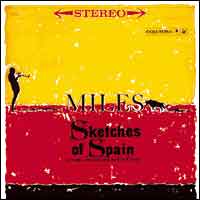 Obwohl
ich wie viele andere im Musikunterricht mit diesem Klassiker der orchestralen
Jazz gequält wurde, muss ich zugeben, dass diese Zusammenarbeit von
Miles Davis und dem Dirigenten und Arrangeur Gil
Evans ein Meisterwerk ist. Mein Verständnis für Orchestermusik
zu entwickeln hat eben ein bisschen länger gedauert. Obwohl
ich wie viele andere im Musikunterricht mit diesem Klassiker der orchestralen
Jazz gequält wurde, muss ich zugeben, dass diese Zusammenarbeit von
Miles Davis und dem Dirigenten und Arrangeur Gil
Evans ein Meisterwerk ist. Mein Verständnis für Orchestermusik
zu entwickeln hat eben ein bisschen länger gedauert. |
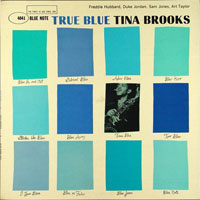
| Tina Brooks: "True Blue" (Blue Note, 1960) |
 [Sonny Rollins |
John Coltrane |
Joe Henderson |
Wayne Shorter |
Hank Mobley |
Freddie Hubbard]
[Sonny Rollins |
John Coltrane |
Joe Henderson |
Wayne Shorter |
Hank Mobley |
Freddie Hubbard]
Mehr ...
Tenor saxophonist Harold “Tina” Brooks recorded five albums in all for Blue Note but only one, True Blue, was released during his lifetime. Originally from Fayetteville, North Carolina, Brooks was an exponent of hard bop and played as a sideman for Kenny Burrell and Freddie Hubbard on Blue Note studio dates before Alfred Lion recorded him as a leader. Hubbard appears on True Blue, together with pianist Duke Jordan, bassist Sam Jones and drummer Art Taylor, who offer sterling support throughout the six-track album. Apart from the closing standard “Nothing Ever Changes My Love For You,” Brooks serves up five original and consistently strong compositions, ranging from the finger-snapping “Good Old Soul” to the more urgent “Miss Hazel.”
(www.udiscovermusic.com)
|
| John Coltrane: "Giant Steps" (Atlantic, 1960) |
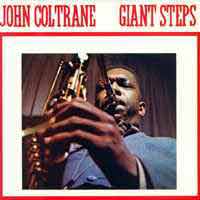 Im
Quartett mit Paul Chambers (Bass),
Tommy Flanagan (Piano) und Art
Taylor (Schlagzeug) eingespielter und von Atlantic-Legende Tom
Dowd produzierter Klassiker des Modernjazz. Viele der Coltrane-Kompositionen
sind schon lange Bestandteil des Jazz-Standardrepertoires, z.B. der Titelsong
und "Naima". Im
Quartett mit Paul Chambers (Bass),
Tommy Flanagan (Piano) und Art
Taylor (Schlagzeug) eingespielter und von Atlantic-Legende Tom
Dowd produzierter Klassiker des Modernjazz. Viele der Coltrane-Kompositionen
sind schon lange Bestandteil des Jazz-Standardrepertoires, z.B. der Titelsong
und "Naima".
Mehr ...
Recorded in 1959 while Coltrane was still playing in Miles Davis’ band, Giant Steps marked a significant stride forward for the saxophonist, who, with the title track in particular – based on a cyclical series of descending chord changes – captured perhaps the ultimate expression of bebop. Having taken bebop to its limits, it was no wonder that Trane changed musical direction after this album, opting to explore modal jazz, which offered more freedom for improvisation. As well as the classic title song, Giant Steps included the haunting ballad ‘Naima’, named after his first wife. Other memorable cuts on the album were the hard-swinging hard bop outings ‘Cousin Mary’ and ‘Syeeda’s Song Flute’.
(www.udiscovermusic.com)
History will undoubtedly enshrine this disc as a watershed the likes
of which may never truly be appreciated. Giant Steps bore the double-edged
sword of furthering the cause of the music as well as delivering it to
an increasingly mainstream audience. Although this was John Coltrane's
debut for Atlantic, he was concurrently performing and recording with
Miles Davis. Within the space of less than three weeks, Coltrane would
complete his work with Davis and company on another genre-defining disc,
Kind of Blue, before commencing his efforts on this one. Coltrane (tenor
sax) is flanked by essentially two different trios. Recording commenced
in early May of 1959 with a pair of sessions that featured Tommy Flanagan
(piano) and Art Taylor (drums), as well as Paul Chambers -- who was the
only band member other than Coltrane to have performed on every date.
When recording resumed in December of that year, Wynton Kelly (piano)
and Jimmy Cobb (drums) were instated -- replicating the lineup featured
on Kind of Blue, sans Miles Davis of course. At the heart of these recordings,
however, is the laser-beam focus of Coltrane's tenor solos. All seven
pieces issued on the original Giant Steps are likewise Coltrane compositions.
He was, in essence, beginning to rewrite the jazz canon with material
that would be centered on solos -- the 180-degree antithesis of the art
form up to that point. These arrangements would create a place for the
solo to become infinitely more compelling. This would culminate in a frenetic
performance style that noted jazz journalist Ira Gitler accurately dubbed
"sheets of sound." Coltrane's polytonal torrents extricate the
amicable and otherwise cordial solos that had begun decaying the very
exigency of the genre -- turning it into the equivalent of easy listening.
He wastes no time as the disc's title track immediately indicates a progression
from which there would be no looking back. Line upon line of highly cerebral
improvisation snake between the melody and solos, practically fusing the
two. The resolute intensity of "Countdown" does more to modernize
jazz in 141 seconds than many artists do in their entire careers. Tellingly,
the contrasting and ultimately pastoral "Naima" was the last
tune to be recorded, and is the only track on the original long-player
to feature the Kind of Blue quartet. What is lost in tempo is more than
recouped in intrinsic melodic beauty. Both Giant Steps [Deluxe Edition]
and the seven-disc Heavyweight Champion: The Complete Atlantic Recordings
offer more comprehensive presentations of these sessions.
(by Lindsay Planer, All Music Guide)
|
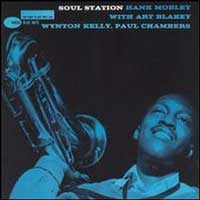
| Hank Mobley: "Soul Station" (Blue Note, 1960) |
 [Giant Steps (John Coltrane, 1960) |
The Bridge (Sonny Rollins, 1962) |
Kind Of Blue (Miles Davis, 1959) |
Art Blakey]
[Giant Steps (John Coltrane, 1960) |
The Bridge (Sonny Rollins, 1962) |
Kind Of Blue (Miles Davis, 1959) |
Art Blakey]
Mehr ...
A virtuoso saxophonist who has often been criminally underrated – perhaps because he wasn’t a pathfinder in the mould of revolutionary figures such as Coltrane or Ornette Coleman – Hank Mobley was, nevertheless, a pivotal and prolific figure in the evolution of hard bop, recording a whopping 26 albums for Blue Note between 1955 and 1970. Though his output was consistently good and rarely dipped in quality, one album stands head and shoulders above the rest to earn its place in this guide to Blue Note: Soul Station. Recorded in February 1960, it finds Mobley leading a stellar quartet comprised of Miles Davis band members – pianist Wynton Kelly and bassist Paul Chambers – plus über-drummer Art Blakey. The sprightly but mellow opener, Irving Berlin’s ‘Remember’, is the chief standout, highlighting Mobley’s gorgeous, well-rounded tone. It’s one of two fine covers on the album, but the tenor saxophonist also impresses on three striking originals, including a funky, finger-clicking soul jazz groove called ‘Dig Dis’ and the bluesy, slow-paced title song.
(www.udiscovermusic.com)
An often underrated tenor saxophonist whose mellow, sonorous style was overshadowed by the more visceral approach of his contemporaries, Georgia-born Hank Mobley nevertheless belongs in the pantheon of jazz’s elite horn players. He recorded 26 album sessions for Blue Note, of which Soul Station is the most remarkable. Featuring high-caliber sidemen – Wynton Kelly, Paul Chambers, and Art Blakey – the album finds Mobley in irresistible form. In addition to four superlative original numbers, Mobley provides soulful interpretations of two standards, including a beautiful rendition of Irving Berlin’s “Remember.”
(www.udiscovermusic.com)
|