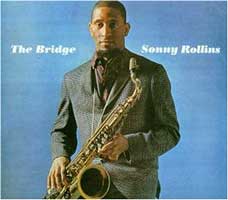
| Sonny Rollins: "The Bridge" (RCA/Victor, April 1962) |
 Schöne
Quartettplatte eines der weltbesten Tenorsaxofonisten! Und mit über
70 Jahren ist der Mann auch heute noch sehr gut dabei, wovon ich mich
vor wenigen Wochen im Landschaftspark Duisburg überzeugen konnte. Schöne
Quartettplatte eines der weltbesten Tenorsaxofonisten! Und mit über
70 Jahren ist der Mann auch heute noch sehr gut dabei, wovon ich mich
vor wenigen Wochen im Landschaftspark Duisburg überzeugen konnte.
"The Bridge" entstand nach einer zweijährigen schöpferischen
Pause, in der er hoch oben auf einer der New Yorker Brücken fleissig
Saxofon geübt haben soll. Es begleiten ihn hier der unvergleichliche
Jim Hall an der Gitarre, Ben Riley am Schlagzeug und Bob
Cranshaw am Kontrabass. Letzterer stand (bzw. saß auch neulich in
Duisburg wieder (oder noch immer?) auf der Bühne, inzwischen allerdings
an der 6saitigen Bassgitarre, und sogar noch ein oder zwei Jährchen
älter als sein Chef!
(20.07.2006)

 Mehr ...
|
Sonny Rollins wird unbestritten als der wichtigste und der beste Tenorsaxofonist
der Welt angesehen. Er hat ein außergewöhnliches Erbe an Aufnahmen
hinterlassen. Er begann als Begleitmusiker in den späten 40er-Jahren
und arbeitete zusammen mit Charlie Parker, Fats Navarro, Bud Powell, Max
Roach, Clifford Brown, Thelonious Monk, Art Blakey und Miles Davis. Seit
der ersten Aufnahme als Bandleader (1954) hat Rollins Dutzende von Alben
für zahlreiche Plattenfirmen aufgenommen, bis er schließlich
für eine längere Phase bei Milestone verblieb. The Bridge wurde
1962 für RCA aufgenommen und gehört zu den dramatischsten Aufnahmen
von Rollins: Sie markiert die Rückkehr nach drei Jahren selbst auferlegter
Pause, und der Titel-Track ist eine Anspielung auf das Gerücht, dass
Rollins einen großen Teil dieser Zeit damit verbrachte, auf der
Williamsburg Bridge ganz allein zu üben.
Die Band-Zusammenstellung für The Bridge ist für diese Zeit
ungewöhnlich, ein Quartett mit einer Gitarre (Jim Hall) anstatt eines
Pianos. Die anderen Mitglieder der Band, der Bassist Ben Cranshaw und
abwechselnd Ben Riley oder Harry Saunders am Schlagzeug, dienen ganz einfach
nur dazu, für Sonny Rollins den entsprechenden Rahmen zu schaffen,
bei dem die schöpferische Pause offensichtlich seine bereits vorher
schon unglaublichen Fähigkeiten weiter entwickelt hat. Zusammen mit
dem Titel-Track gehören zu den herausragenden Werken dieses Albums
"Without A Song" und "God Bless The Child".
(Fred Goodman, www.amazon.de)
|
|
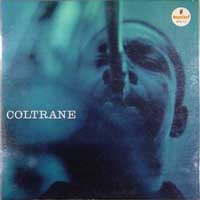
| John Coltrane: "Coltrane" (Impulse!, Okt. 1962) |
 [McCoy Tyner]
Mehr ...
Coltrane was in the middle of his modal period when he made this album, which came out a year after My Favourite Things. At this point, he still wasn’t averse to recording standards but his 14-minute ‘Out Of This World’ – written by Harold Arlen with Johnny Mercer – is unrecognisable from the original. The same can be said for a wild soprano-sax-led reading of Frank Loesser’s ‘The Inch Worm’, in 3/4 time. Both tunes, however, epitomise Trane’s freer approach to improvisation, as he blows over open-ended two-chord grooves. Of Trane’s own tunes on Coltrane, the meditative ‘Tunji’ anticipates the spiritual quest of A Love Supreme.
(www.udiscovermusic.com)
|
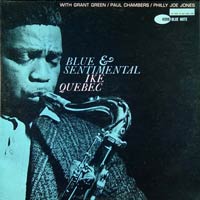
| Ike Quebec: "Blue And Sentimental" (Blue Note, 1962) |
 [It Might As Well Be Spring (Ike Quebec, 1964) |
Idle Moments (Grant Green, 1964)]
[It Might As Well Be Spring (Ike Quebec, 1964) |
Idle Moments (Grant Green, 1964)]
Mehr ...
Ike Quebec's 1961-1962 comeback albums for Blue Note were all pretty rewarding, but Blue and Sentimental is his signature statement of the bunch, a superbly sensuous blend of lusty blues swagger and achingly romantic ballads. True, there's no shortage of that on Quebec's other Blue Note dates, but Blue and Sentimental is the most exquisitely perfected. Quebec was a master of mood and atmosphere, and the well-paced program here sustains his smoky, late-night magic with the greatest consistency of tone. Part of the reason is that Quebec's caressing tenor sound is given a sparer backing than usual, with no pianist among the quartet of guitarist Grant Green, bassist Paul Chambers, and drummer Philly Joe Jones. It's no surprise that Green solos with tremendous taste and elegance (the two also teamed up on Green's similarly excellent Born to Be Blue), and there are plenty of open spaces in the ensemble for Quebec to shine through. His rendition of the Count Basie-associated title cut is a classic, and the other standard on the original LP, "Don't Take Your Love From Me," is in a similarly melancholy vein. Green contributes a classic-style blues in "Blues for Charlie," and Quebec's two originals, "Minor Impulse" and "Like," have more complex chord changes but swing low and easy. Through it all, Quebec remains the quintessential seducer, striking just the right balance between sophistication and earthiness, confidence and vulnerability, joy and longing. It's enough to make Blue and Sentimental a quiet, sorely underrated masterpiece.
(by Steve Huey, All Music Guide)
|
(2007-07-02)