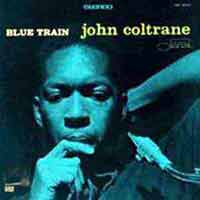
This album, recorded in September 1957, marked John Coltrane’s comeback after his heroin use led to his ejection from Miles Davis’ band earlier in the year. After going cold turkey and successfully beating his addiction, Coltrane was a man reborn whose music became more sharply focused, especially after he began working with Thelonious Monk. He was still playing with Monk’s quintet when he recorded Blue Train with a sextet that included young trumpet genius Lee Morgan. All but one of the tunes is by the saxophonist, and it’s the title cut, with its memorable clarion call theme, which is the stand-out. Widely acknowledged as Trane’s first masterpiece, anyone looking to buy John Coltrane for the first time needs to start here.
(www.udiscovermusic.com)
Blue Train was the first of several musical masterpieces that Coltrane would create in his short recording career. It came at a time when the saxophonist, who had transformed his life after overcoming heroin addiction, was playing with Thelonious Monk and honing his famous “sheets of sound” style. Though “Trane” had a deal with Prestige, he negotiated to do a one-off LP for Blue Note. The resulting album, rendered in a hard bop style, was the catalyst that kick-started his solo career. Thanks to the presence of Curtis Fuller’s resonant trombone, Blue Train offered a unique sonic signature with its three-horn frontline. It also showcased Coltrane’s advances as both an improviser and composer, especially on the magnificent title track and “Locomotion.”
(www.udiscovermusic.com)
Although never formally signed, an oral agreement between John Coltrane and Blue Note Records founder Alfred Lion was indeed honored on Blue Train -- Coltrane's only collection of sides as a principal artist for the venerable label. The disc is packed solid with sonic evidence of Coltrane's innate leadership abilities. He not only addresses the tunes at hand, but also simultaneously reinvents himself as a multifaceted interpreter of both hard bop as well as sensitive balladry -- touching upon all forms in between. The personnel on Blue Train is arguably as impressive as what they're playing. Joining Coltrane (tenor sax) are Lee Morgan (trumpet), Curtis Fuller (trombone), Kenny Drew (piano), Paul Chambers (bass), and Philly Joe Jones (drums). The triple horn arrangements incorporate an additional sonic density that remains a trademark unique to both this band and album. Of particular note is Fuller's even-toned trombone, which bops throughout the title track as well as the frenetic "Moments Notice." Other solos include Paul Chambers' subtly understated riffs on "Blue Train" as well as the high energy and impact from contributions by Lee Morgan and Kenny Drew during "Locomotion." The track likewise features some brief but vital contributions from Philly Joe Jones -- whose efforts throughout the record stand among his personal best. Of the five sides that comprise the original Blue Train, the Jerome Kern/Johnny Mercer ballad "I'm Old Fashioned" is the only cover tune in the stack. In terms of unadulterated sentiment, this version is arguably untouchable. Fuller's rich tones and Drew's tastefully executed solos cleanly wrap around Jones' steadily languid rhythms. This is sheer jazz nirvana. In the spring of 1997, the Ultimate Blue Train CD was released, boasting 20-bit remastered audio as well as one alternate take of both "Blue Train" and "Lazy Bird." Additionally, the disc includes "At Least Listen" -- an interactive CD-ROM program featuring video clips and interview clips with Fuller circa 1995, as well as many brilliant photographs taken during the recording sessions. Without reservation, Blue Train can easily be considered in and among the most important and influential entries not only of John Coltrane's career, but of the entire genre of jazz music as well.
(by Lindsay Planer, All Music Guide)
Recorded as a one-off while he was still contracted to the Prestige label, Blue Train was John Coltrane’s only solo offering for Alfred Lion and Francis Wolff’s imprint. Recorded in late 1957, after the saxophonist had gone “cold turkey” to quit the heroin addiction that got him fired from Miles Davis’ band earlier in the year, Blue Train marked his rebirth as a drug-free musician. Perhaps because of this, it was Trane’s first truly exceptional long-player and showed him living up to the promise he had shown before drugs threatened to derail his career. Coltrane leads a sextet with a three-horn frontline that includes trumpeter Lee Morgan and trombonist Curtis Fuller, the latter bringing a rich sonority to the album. The opening title tune, with its memorable clarion call horn theme, is one of Coltrane’s classic compositions and offers a vivid example of his ornate “sheets of sound” soloing style in a hard bop setting. The only cover among the album’s five tunes is the Johnny Mercer-Jerome Kern-written ‘I’m Old Fashioned’, a plaintive ballad on which Coltrane favours deep emotional expression over flashy displays of technique. Not only an essential entry in any guide to Blue Note, but one of the first ports of call for anyone interested in John Coltrane, Blue Train is a must-hear album.
(www.udiscovermusic.com)

 #339 Virgin/Colin Larkin(2000)

 Plattentipp